
Description
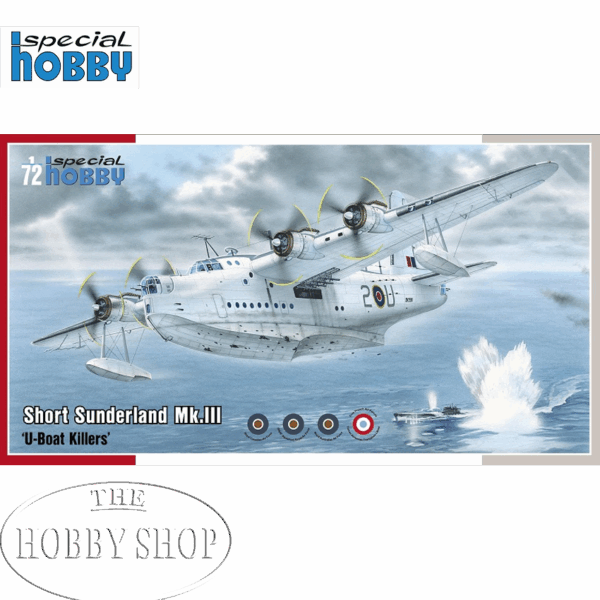
The Sunderland was developed by Short Brothers to an RAF requirement R.2/33 for a long range general purpose flying boat. It is thought Shorts took their work on Imperial Flying Boats to design the Sunderland, however the RAF requirement was released before the Imperial Airways requirements, and Short’s decided to pursue both at the same time. The Sunderland would be a large four engined flying boat with both defensive and offensive armaments. The large wings with would mount 4 Bristol Pegasus engine were able to hold 200 Gallons of fuel giving the aircraft a 14 hour range. For defence initially four guns were mounted in a rear turret, two guns in the nose turret, and two guns on each beam. Later a dorsal turret would be added. Offensive weapons were carried internally and winched out under the wings through doors in the aircrafts sides. Later aircraft would also gain 4 fixed forward firing machine guns. German pilots nicknames the Sunderland the flying porcupine and there are numerous cases of Sunderland fighting off superior numbers off attacking aircraft. Radar fitted to these flying boats enabled them to become accomplished submarine hunters. Production shifted to the Mark III in December of 1941. This had a changed hull to improve seaworthiness. With 461 built this was the most numerous mark.
The Kit
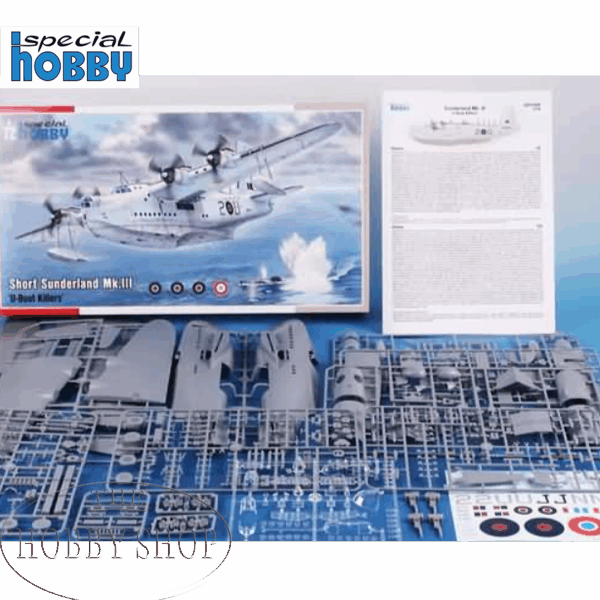
This is a new boxing for the Mark III based on Special Hobby’s new tool Mark V from 2019, with new parts. The parts breakdown on the spures would also indicate other earlier marks are planed as well. This is an impressive kit with good quality large mouldings and a full interior. Construction starts in the cockpit. The instrument panel and pilots seats are built up onto the deck with the control columns being added. The cockpit bulkhead goes in and there is an additional seat to fit on the bulkhead. At the other side what appears to be the navigators position goes in. The lower deck under the cockpit then is assembled with its bunk areas for crew rest on those long flights. The next stage is to build up the weapons carriers and the rails which winch them out under the wings. 8 bombs are provided. The top and main decks can then be joined and the weapons section added to the rear of this sub-assembly. To the front is added the mooring deck/access to the front turret with a realistic grating effect to the floor, Additional parts can now be added inside both main fuselage halves before you can think about closing them up around the main internal section. The modeller can have the weapons windows open or closed but this needs to be done now as they swing inwards. At the rear of the main cabin the gunners position and access to the top turret parts need then to be added. At the bow the anchor needs to go in. Only once all this is done can the fuselage be closed up.